


In this short video, Frank Golden offers reassurance to Intended Parents and Surrogates after miscarriage or pregnancy loss in a Surrogacy Journey, reminding them that setbacks can happen even when everyone has done everything right.
Quick answer: A failed embryo transfer or pregnancy loss in surrogacy can happen even when the embryo, clinic preparation, Surrogate screening, and transfer plan all appear strong. It does not automatically mean the Intended Parents, Surrogate, or agency did anything wrong. In this deeply personal reflection, Frank Golden shares how he and Adam endured multiple failed transfers before welcoming their son, Silas, and why compassion, realistic expectations, and continued medical guidance matter after a setback.
Our personal path to parenthood
My personal path to parenthood has not been easy. This is partly because I am a gay man, but even more so because of the life circumstances leading up to the creation of my family. I went through a period in my life, an exceptionally melancholy period, in which I questioned my meaning and my purpose. I had recently lost a series of close family members and friends. After the unexpected death of my brother, I fell into a particularly deep depression.
My mom and I were the sole survivors of our entire family. We only had each other, and our bond grew strong. In my mom’s eyes, I saw such sadness and such love. She had the eyes of a parent in mourning. I knew then that it was my responsibility to have a child and carry on our bloodline. This period of my life, albeit painful, changed the way I viewed the world and ultimately led me to where I am today.
When I met Adam, I made it clear that I wanted a family. For all couples, this is a conversation that needs to happen. As our relationship got more serious, I began thoroughly researching surrogacy. My mind was set: we were going to create a family with the help of a Surrogate. I wanted to expand my lineage, not as an attempt to recreate my brother, but as an attempt to honor his memory. Most of all, I wanted to do it for my mom and for the son she lost.
When everything looks right and a transfer still fails
Adam and I began our first Surrogacy Journey in 2011. After selecting our egg donor, IVF clinic, and agency, we were matched with our Surrogate. We created our embryos, or our “soon to be children,” as we called them. At the risk of sounding boastful, I must say that our embryos were beautiful. Perhaps I was just the typical, overly proud parent, but they felt like the most beautiful creations ever.
We did everything right. This began with selecting our egg donor from a credible source. Next, our team genetically tested the embryos to select the best ones for transfer. Our Surrogate followed the protocol perfectly and responded well to her medication cycle. There was a strong belief that we deserved a successful transfer because we had worked so hard to reach that point. At the time, we expected to have twins. I know how naïve that sounds now, but at the time, we didn’t know any better. Although we were aware of the possibility of a failed transfer, we didn’t think it would happen to us.
Frank and Adam’s personal experience with failed embryo transfers

Our first transfer was bittersweet. One of our embryos stuck, and the other did not. It was not until Sophia was born that we knew whose embryo was successful and whose had failed. At that point, it did not matter. We had our baby. As a gay couple, our family was a symbol of pride and perseverance. Sophia, although genetically related to Adam, was my daughter as much as she was his. In her eyes, I saw Adam’s eyes.
However, the whirlwind of being a new parent was often a distraction for the pangs of sadness I felt over the loss of my embryo. I had three remaining embryos left. Those embryos held my dreams and my hopes. I had faith going into the process for a second time, but that faith wavered when the next transfer failed. We transferred both remaining embryos, and neither implanted. All my embryos were gone, and with them, my hope.
Why a failed transfer can feel like personal failure
When your embryo fails, you often feel like a failure yourself. I felt this way, and many of our Intended Parents tell me they feel this way too. I questioned myself and I questioned my DNA. It is a state of helplessness that is hard to describe to those who have not lived it.
Eventually, we attempted another journey. We retrieved more eggs from our donor and resulted in three viable embryos. These were our last three. At this point, we were starting to accept the possibility that Sophia would be an only child. We were on our third Surrogate when we transferred the best embryo of that batch, and once again, we waited. We had become used to waiting and, unfortunately, we had become used to failed transfers. That first transfer failed too.
When a Surrogacy Journey includes miscarriage or pregnancy loss
While a failed embryo transfer is a heavy burden, a pregnancy loss or miscarriage during a Surrogacy Journey brings a different level of grief. It is important to recognize that this can happen. Even when embryos appear strong and the clinical plan has been carefully prepared, a pregnancy may still end in loss. If you are going through this, please know you are not alone.
A miscarriage can occur even when the Intended Parents, the Surrogate, and the clinical team have done everything asked of them. In our experience at Golden, many of the early losses we have seen are identified before heartbeat detection, though every case is different and the fertility physician should guide what comes next. A loss is a setback, but it is not necessarily the end of the road. Readers seeking general medical background may also find ACOG’s overview of early pregnancy loss helpful, while case-specific guidance should always come from the fertility physician.
Why Surrogates should not blame themselves
One of the most important things for a Surrogate to hear after a loss or a failed transfer is that she is not to blame. Surrogates are often deeply invested in the success of the journey. They follow strict medication calendars, attend every appointment, and care for their bodies with immense dedication. When a transfer fails or a pregnancy ends, a Surrogate may feel like she let the Intended Parents down.
We must remember that a Surrogate is not a robot or a machine. She is a living, breathing person with her own emotions. Even when medication instructions are followed, monitoring appears reassuring, and screening has been completed, implantation or early loss can still occur for reasons that may not be immediately clear. That uncertainty is painful, but it does not mean the Surrogate failed anyone. A Surrogate should not feel that she did something wrong when she has given the process her full care and attention.
Why Intended Parents should not blame their Surrogate
It is common for Intended Parents to feel the need to “fix” the situation after a failed transfer. Sometimes, this manifests as a desire to find a new Surrogate. We encourage Intended Parents to approach the next step thoughtfully and in coordination with the fertility physician. When the physician remains comfortable proceeding, and there is no medical reason to end the match, continuity may still be the right path forward.
Your Surrogate genuinely wants to help you build your family. A failed transfer is just as disheartening for her as it is for you. If you are working with Golden, your Surrogate has already completed careful surrogate screening requirements before being presented for a match. Trust the process and trust the woman who has committed herself to your dream.
What happens next after a failed transfer or loss

When a transfer fails or a loss occurs, the first step is to pause and breathe. The fertility physician will review the cycle history and the pregnancy data to look for any patterns. They will then regroup with the Intended Parents and the Surrogate to advise on the next clinical steps.
Depending on the circumstances, the physician may discuss whether additional evaluation, protocol adjustments, or another transfer are appropriate. Compassion and patience are the most valuable tools you have during this time. You can find more answers to common questions in our Intended Parent FAQ.
Staying cautiously optimistic during uncertainty
Surrogacy and IVF are not exact sciences. There are no guarantees in this process. We always encourage our Intended Parents to be positive and excited because this is a monumental step in their lives. However, we also encourage them to be realistic. I like to call this being “cautiously optimistic.”
Understanding the possibilities helps in managing expectations as an Intended Parent. A failed transfer is a “fail” in the clinical sense, but it is not a failure of the heart. My personal experience is proof that sometimes the path to success requires us to walk through a few disappointments first.
Historical note on double embryo transfer and Golden’s current policy
During our personal journey, Adam and I often chose to transfer two embryos at a time. We did this because we wanted twins and, truthfully, we wanted to save on costs. At that point in our personal journey, and under the guidance of our treating fertility team, we proceeded based on the medical recommendations and circumstances in front of us at the time.
It is important to note that Golden’s agency policy today is different. In most gestational surrogacy journeys, we only support single embryo transfer as the safer standard for both the Surrogate and the baby. We do not frame double embryo transfer as a shortcut to success. You can learn more about why Golden does not support double embryo transfers in most surrogacy journeys and how it protects the health of everyone involved.
Finding meaning after repeated setbacks
We will never truly know why so many of my embryos did not “stick”. They were high-grade embryos, and our Surrogates appeared well prepared for transfer. To us, they felt as though they should have worked, but they did not. That is the reality of IVF. You can create the perfect environment and do everything right, and you still face the risk of a setback.
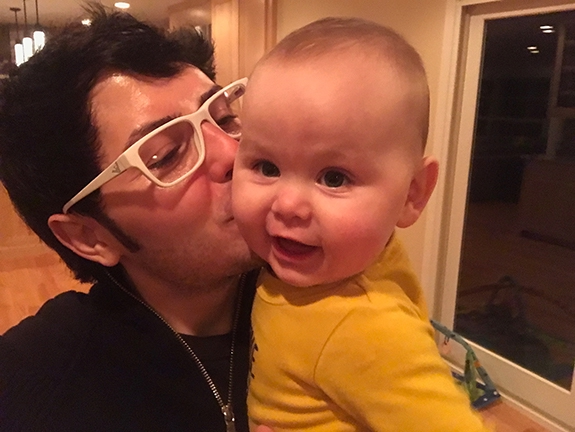
For me, these moments did not mean it was time to give up. They became part of the path that ultimately led us to Silas. If I had stopped after my first, second, third, or fourth failed transfer, I would not have him. For such a scientific process, there is a deeply spiritual element that plays a part. I believe that every failed transfer is just the universe’s way of bringing you the child you were always meant to have. I firmly believe this, and so does Adam.
Taking the next step with Golden Surrogacy
If you are an Intended Parent facing disappointment after a failed transfer or pregnancy loss, you are not alone. Golden understands that these moments can be deeply painful, and we believe families deserve both honesty and compassionate guidance as they consider what comes next.
Learn more about why Intended Parents choose Golden, or begin your path to parenthood with Golden Surrogacy when you are ready. We are here to guide you through every step of the Surrogacy Journey, no matter how many turns the path may take.