

In this short video, Frank Golden explains what gestational surrogacy is, how it works, and why a Gestational Surrogate is not giving up her own baby.
One of the most common misunderstandings about surrogacy is the belief that a Surrogate is carrying or “giving up” her own child.
In the gestational surrogacy model, recommended by Golden and most professionally supported U.S. surrogacy programs, that is not how the process works.
The distinction between gestational surrogacy and traditional surrogacy begins with genetics.
It comes down to whether the woman carrying the pregnancy has a biological connection to the child.
Understanding this difference is one of the first steps for anyone learning how modern gestational surrogacy works.
Quick answer: In gestational surrogacy, the Surrogate carries a pregnancy for Intended Parents but is not genetically related to the baby. The embryo is created through IVF using the Intended Parents’ or donors’ eggs and sperm, then transferred to the Gestational Surrogate. In traditional surrogacy, the person carrying the pregnancy also provides the egg, which creates a genetic connection to the child. Golden Surrogacy only facilitates gestational surrogacy arrangements.
What is gestational surrogacy?
Gestational surrogacy is the most common form of surrogacy today.
In this arrangement, the woman who carries the pregnancy (the Gestational Surrogate) has no genetic link to the baby.
According to the American Society for Reproductive Medicine (ASRM), a gestational carrier provides gestation but does not provide the eggs used to create the pregnancy.
Furthermore, the embryos are created in a laboratory environment using In Vitro Fertilization (IVF).
For some Intended Parents, embryo creation may also involve donor eggs, which is why it can be helpful to understand how to choose an egg donor for a Surrogacy Journey.
Because the Gestational Surrogate does not provide the egg, she is not genetically related to the child.
This process involves a person carrying a genetically unrelated child with the help of assisted reproductive technology.
What is traditional surrogacy?
Traditional surrogacy, which is sometimes called genetic surrogacy, is an older form of family building.
In these cases, the Surrogate is also the egg donor.
In traditional surrogacy, the Surrogate’s own egg is used to create the pregnancy, often through insemination rather than embryo transfer.
Because her own eggs are used, the traditional Surrogate is genetically related to the baby she is carrying.
While this was once the standard model for surrogacy, it has become much less common in recent decades.
The increased medical, legal, and emotional complexities involved make it a rarer choice for modern families.
Gestational vs. Traditional surrogacy: the key difference
The core difference between these two paths is the genetic relationship to the child. The Gestational Surrogate carries the pregnancy for the Intended Parents but does not contribute genetic material to the child.
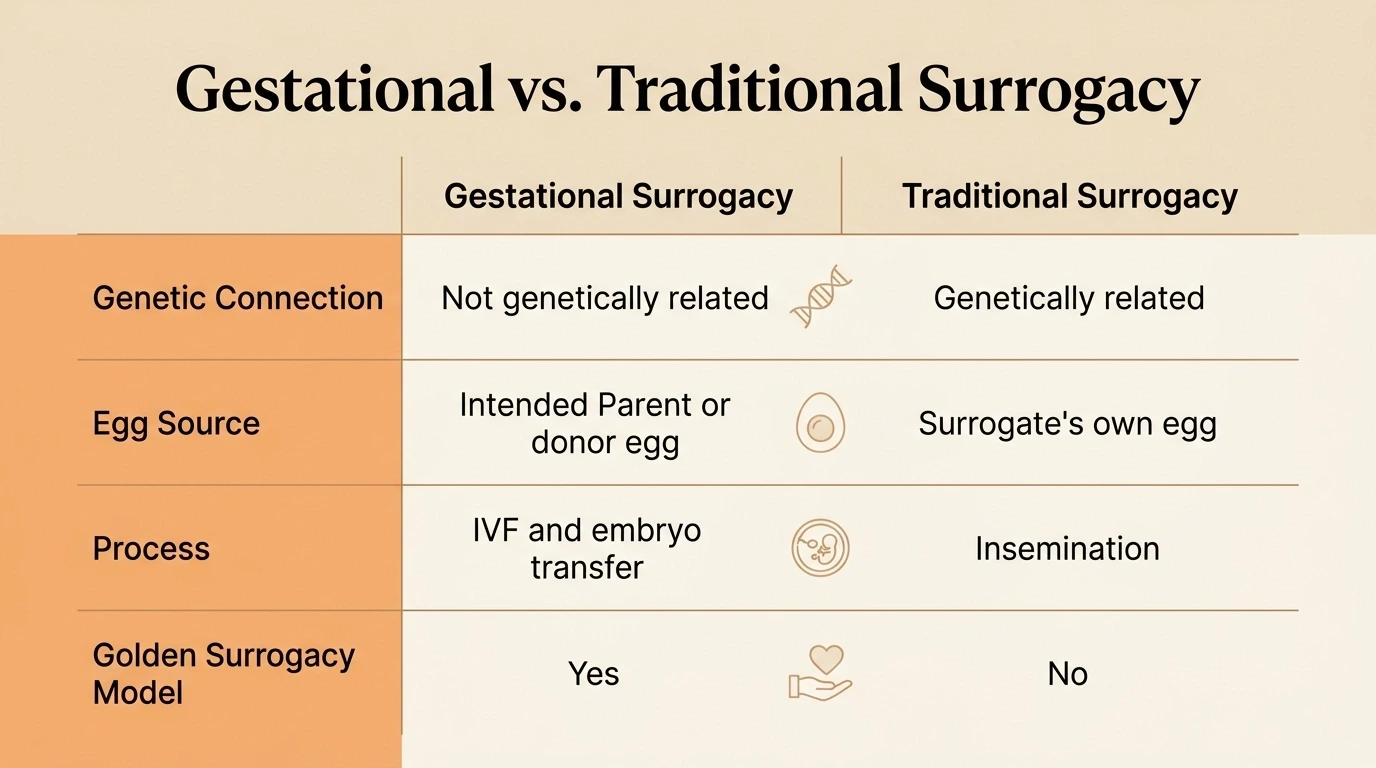
In gestational surrogacy, there is no genetic connection between the Surrogate and the child. The Gestational Surrogate carries the pregnancy for the Intended Parents but does not contribute genetic material to the child.
In traditional surrogacy, the person carrying the pregnancy also provides the egg, creating a direct genetic connection to the child.
At Golden Surrogacy, we believe that clear boundaries and ethical safeguards are essential for a healthy Surrogacy Journey.
Therefore, our program is focused exclusively on gestational surrogacy arrangements.
This clarity helps protect the emotional well-being of all parties involved in the process.
Is a Gestational Surrogate genetically related to the baby?
No, a Gestational Surrogate does not share any DNA with the baby she carries.
This distinction is important for both Intended Parents and prospective Surrogates. In gestational surrogacy, the pregnancy does not involve the Surrogate’s own eggs or create a genetic relationship between the Surrogate and the child.
Because the eggs used to create the embryo come from the Intended Mother or an egg donor, the Surrogate’s genetics do not pass to the child.
She provides the nurturing environment of her womb to help the baby grow and develop.
However, the child’s genetic blueprint remains entirely separate from her own biological makeup.
Are Surrogates giving up their own babies?
This is one of the most common misconceptions about gestational surrogacy.
In a gestational Surrogacy Journey, a Surrogate is not giving up a baby because the baby was never hers to begin with.
She enters the process with the clear intention of carrying a child for someone else.
From the very first conversation, the mindset is one of help, service, and generosity.
She is not surrendering a child. She is carrying a baby for the Intended Parents who have been preparing to welcome their child.
For more Surrogate-specific information, you can explore our Surrogate FAQ.
The Surrogate is carrying a baby for the Intended Parents, not surrendering a child of her own.
How gestational surrogacy works through IVF
To facilitate a journey where the Surrogate has no genetic link, we rely on modern IVF technology.
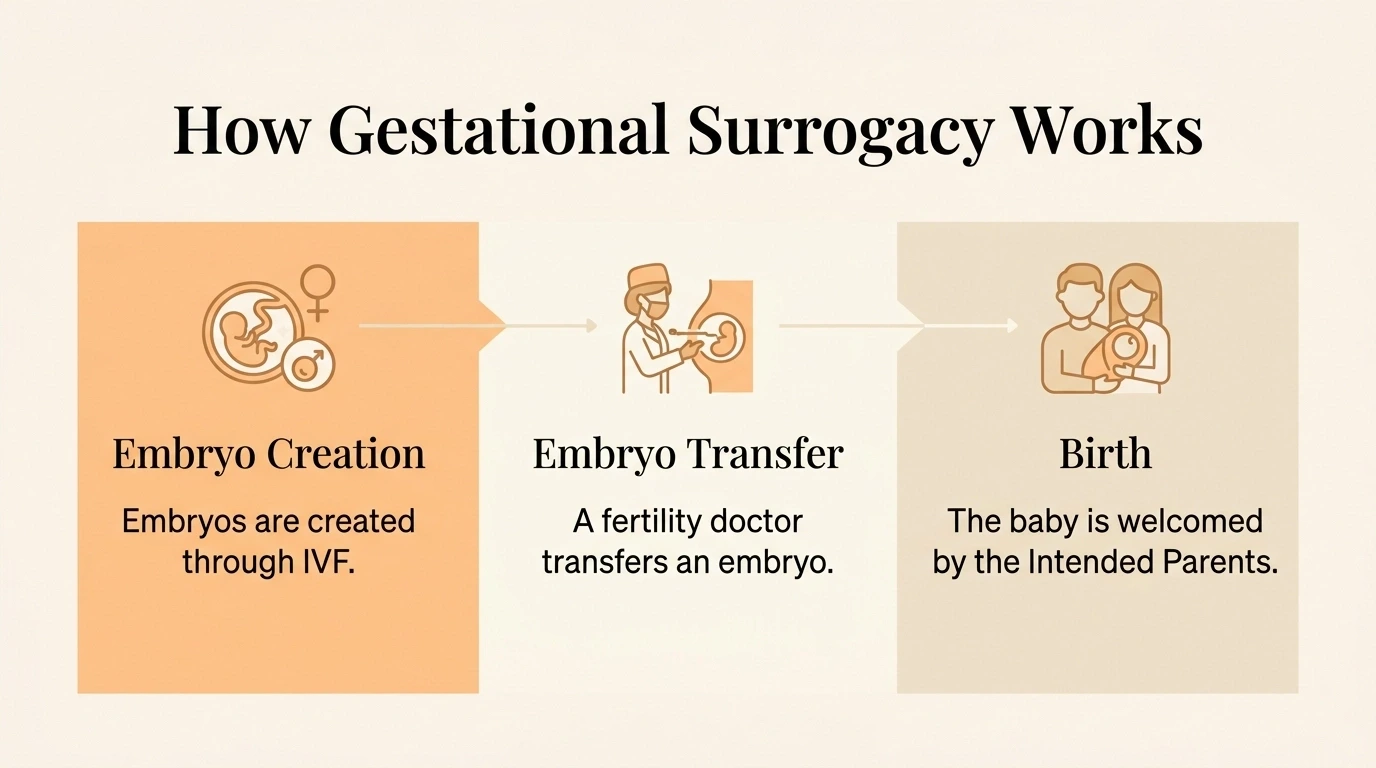
The process generally follows these foundational steps:
First, Intended Parents work with a fertility clinic to create embryos using their own gametes or donor gametes. “Gametes” is the scientific word used to describe human reproductive cells, which include both egg and sperm. Female gametes are called eggs, or ova, while male gametes are called sperm.
If you are still evaluating clinics, our guide on how to choose the best IVF clinic for surrogacy can help you understand what to compare.
Next, Golden Surrogacy facilitates a mutual match between the Intended Parents and a qualified Surrogate.
Once the match, medical clearance, legal work, and required next steps are complete, a fertility physician transfers an embryo into the Surrogate’s uterus.
If pregnancy is achieved, the Surrogate continues with prenatal care under the guidance of her obstetric providers.
When the pregnancy results in birth, the baby is welcomed by the Intended Parents, with parentage and hospital processes handled according to the applicable legal plan.
This process involves coordinated medical, legal, and agency support so that each stage is handled carefully and with clear expectations.
You can read more about how we vet our Surrogates on our screening requirements page.
Why Golden Surrogacy works only with gestational surrogacy
We have intentionally chosen to manage only gestational surrogacy arrangements at Golden.
This decision is rooted in our commitment to providing a secure and ethical experience.
Traditional surrogacy creates a genetic connection between the person carrying the pregnancy and the child, which can add substantial legal, emotional, and practical complexity.
By focusing on gestational surrogacy, we ensure that the roles of every participant are clearly defined from day one.
This creates a foundation of trust that is vital for a successful Surrogacy Journey.
This focus is also consistent with the contemporary professional framework surrounding gestational surrogacy discussed by organizations such as ACOG and ASRM.
We prioritize the clarity, safeguards, and clearly defined roles that the gestational model provides for Intended Parents and Surrogates.
Why this distinction matters for Intended Parents
For Intended Parents, choosing gestational surrogacy often provides a greater sense of security.
It may allow one or both Intended Parents to share a genetic connection with the child when their own gametes are used, while donor gametes may also be part of a family-building plan.
The gestational model can also create a clearer parentage framework, although laws and procedures still vary by state and should be handled by experienced reproductive legal counsel.
Understanding that the Surrogate is not genetically related can alleviate the fear of the unknown.
Many Intended Parents feel reassured knowing that the Gestational Surrogate does not contribute genetic material to the pregnancy, while embryo creation and donor-related considerations are handled separately with the IVF clinic and appropriate professionals.
We invite you to learn more about why parents choose Golden.
Our goal is to make the process as transparent and reassuring as possible for every family.
Why this distinction matters for prospective Surrogates
Women who choose to become Gestational Surrogates often feel a deep sense of pride in their role.
Many Gestational Surrogates have already experienced pregnancy and parenting in their own lives and feel called to help another family without using their own eggs or creating a genetic connection to the child.
If you would like a deeper look at that motivation, read why women become Surrogates.
This distinction is important for understanding what it means to become a Surrogate with Golden.
If you are considering this path, you can review our Surrogate requirements to see if you qualify.
You can also learn more about why women choose our agency on our Why Golden for Surrogates page.
Can a Surrogate keep the baby?
This concern is often shaped by outdated portrayals of surrogacy rather than by how professionally supported gestational surrogacy works today.
In Golden’s gestational surrogacy program, the Surrogate is not genetically related to the child.
That difference matters deeply, and it is one reason gestational surrogacy feels clear and reassuring for so many families and Surrogates.
Just as importantly, each journey includes experienced reproductive legal counsel who prepares the proper agreements and parentage steps well before birth.
Since laws and procedures vary by state, Intended Parents should always rely on their own attorney for legal advice.
At the human level, though, this process is built around shared understanding, clear intentions, and the fact that the Gestational Surrogate is carrying a baby for the Intended Parents, not her own child.
For more details, please see our Intended Parent FAQ.
Common questions about gestational and traditional surrogacy
Is a Gestational Surrogate the baby’s biological mother?
No. A Gestational Surrogate does not provide the egg and is not genetically related to the child. The egg may come from an Intended Parent or an egg donor, depending on the family-building plan.
Does a Surrogate use her own egg?
In traditional surrogacy, the Surrogate does use her own egg.
However, in gestational surrogacy, which is the model we use at Golden, the Surrogate never uses her own egg.
Is traditional surrogacy still used today?
Traditional surrogacy still exists in some private arrangements, but it is far less common in professionally supported U.S. surrogacy. Golden Surrogacy works only with gestational surrogacy because the Surrogate is not genetically related to the child and participant roles are more clearly defined.
Does gestational surrogacy require IVF?
Yes, because the Surrogate is not providing the egg, the embryo must be created in a lab.
The embryo is then transferred to the Surrogate’s uterus during a scheduled medical procedure.
Taking the next step with Golden Surrogacy
Whether you are looking to grow your family or interested in becoming a Surrogate, these basics are essential.
Understanding the genetic difference between these two paths helps you navigate the process with confidence.
At Golden Surrogacy, we provide the high-touch, ethical guidance you need for a successful journey.
Founded by parents who have been through the process themselves, we are here to support you every step of the way.
Our team is dedicated to making sure your experience is as rewarding and clear as possible.
Ready to learn more?